




In a typical fund's lifecycle, GPs have to manage a continuous set of obligations to their LPs: onboarding new investors, issuing capital calls, processing distributions, delivering reporting, and keeping communication accurate and timely.
LP management software is where that work is centralized and run. A well-run LP management system can speed up reporting and capital events and reduce friction between GP and LP.
There are many providers of LP management software in the market, and pricing typically depends on factors like the number of LPs or funds, user counts, features, AI integration, available integrations, and the level of service required.
Criteria To Choosing An LP Management Platform
A good LP management platform should support the following features:
- Granular permissions (fund, LP, and user-level access controls)
- Secure document distribution with watermarking and download restrictions
- Audit logs and investor activity reporting
- Capital call and distribution workflow support (or integrations)
- Strong encryption and authentication options
- AI-powered search and data extraction tools
- High-level investor and entity data organization
10 LP Management Platforms Trusted By Leading GPs
1. Anduin Transact
Anduin is an end-to-end investor operations platform that runs the entire LP relationship in one place, from the first fund opportunity through subscription, onboarding, and the full post-close lifecycle. Instead of stitching together a separate data room, subscription tool, investor portal, and a stack of spreadsheets, Anduin runs all of it on a single infrastructure, so investor data captured once carries forward through every capital event, transfer, vote, and report.
What you can do with Anduin:
Anduin gives GPs and fund administrators one operational layer for every investor activity, replacing the email-and-spreadsheet workflows that usually take over once a fund closes. You can:
- Digitize your exact subscription documents into guided, self-validating forms, with smart data reuse that lets returning LPs pre-fill from past subscriptions instead of starting from scratch
- Run the full post-close lifecycle, including capital additions and redemptions, LP transfers, voting, and wire-instruction updates, on the same infrastructure with LP self-service and built-in identity verification
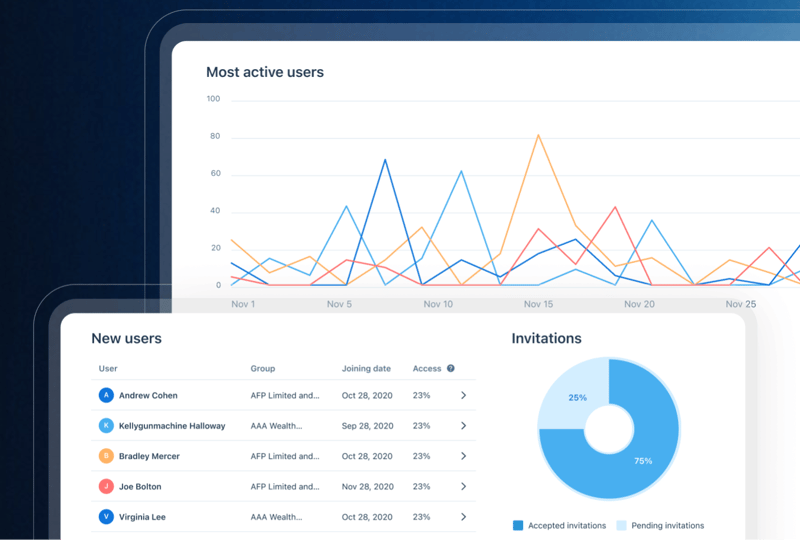
- Track every investor's status in real time from one master dashboard, send reminders, and trigger next steps without chasing updates over email
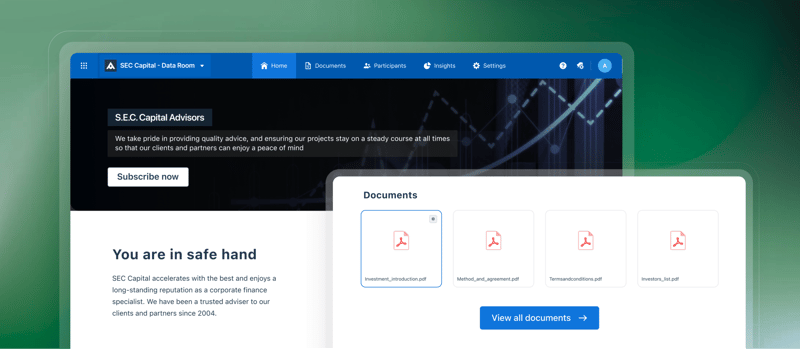
- Give LPs a branded, invite-only hub for documents, communications, and updates that keeps relationships warm between raises
- Keep your CRM and wider tech stack in sync with no-code, two-way integrations, and route investor-activity alerts to Slack, Gmail, Teams, or Outlook
- Auto-generate KYC and AML checklists by investor type and jurisdiction, so compliance is built into the workflow rather than handled as manual triage
Why Anduin stands out:
- One operational layer across the full fund lifecycle. Most LP management stacks break at close: fundraising and subscription run on purpose-built software, then capital activities, transfers, votes, and banking updates fall back into email and spreadsheets. Anduin extends the same subscription infrastructure into post-close, so LP data carries forward with no re-entry and no parallel records.
- LP self-service without added GP risk. Investors initiate and track their own requests, from subscriptions to capital activities, transfers, and banking changes, through guided flows with identity verification built in. Wire-instruction updates require verification before any data changes, closing the email-based fraud gap that most platforms leave open.
- A branded relationship surface, not just a portal. Through Engagement Hub, GPs get a private, invite-only, fully white-labeled destination that carries the fund's identity from first touchpoint through post-close. Newsletters, updates, events, and new-fund opportunities all live in a channel the GP owns, replacing untracked email threads.
- Built for how alternatives actually work. Anduin handles complex structures like VC funds, funds-of-funds, SPVs, and feeders, supports AES and QES e-signatures designed for alternatives, and extends to the RIA and wealth channel with custodian-approved (Schwab) signing through Advisor Advantage. That is depth most general-purpose investor tools do not reach.

2. Juniper Square
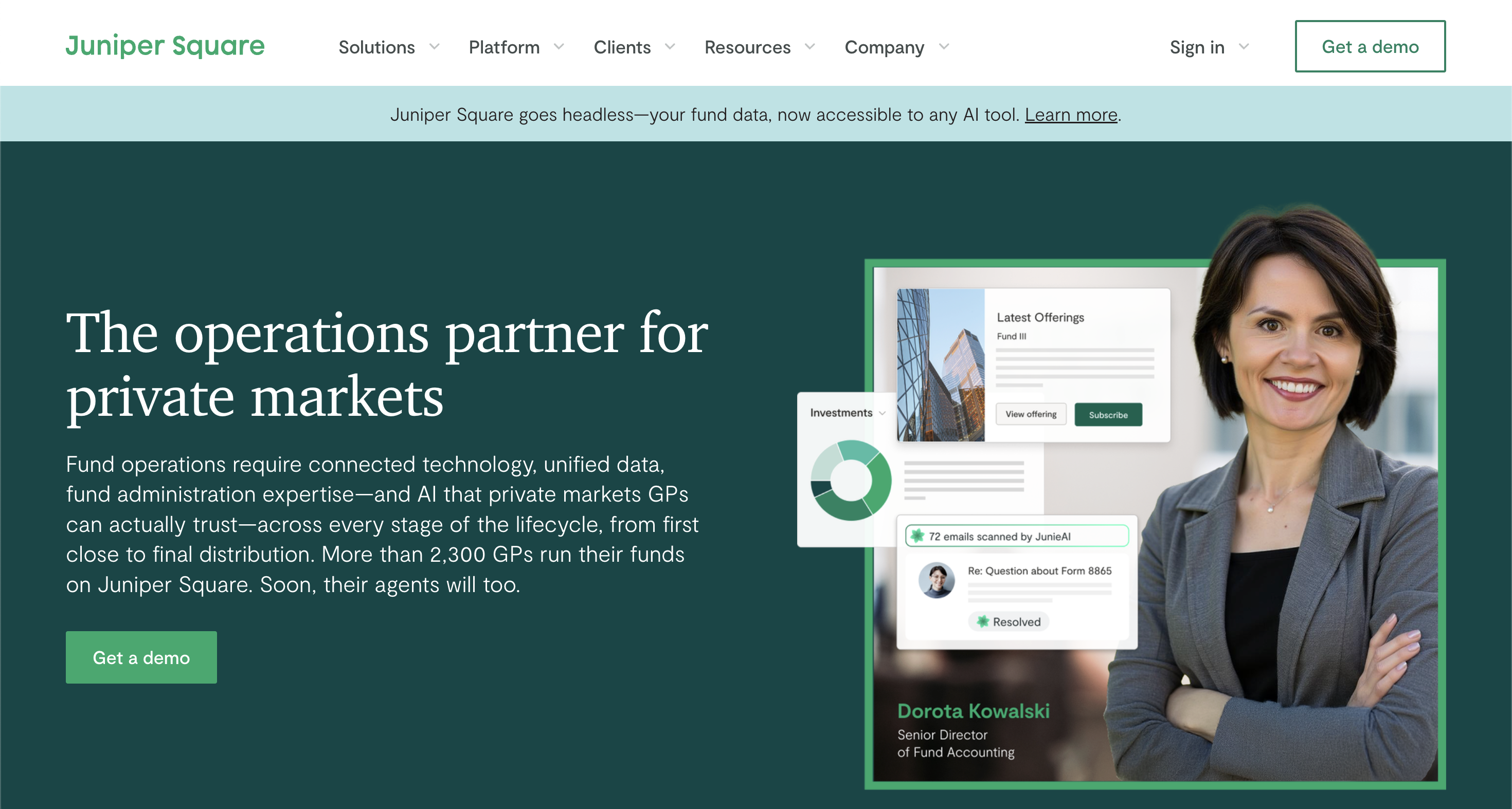
Juniper Square is a fund operations platform built for private markets, combining investor management software with optional outsourced fund administration services. Rather than bolting an investor portal onto a generic CRM, it centralizes the full GP-LP relationship on one system of record, spanning fundraising, onboarding, reporting, and treasury.
- What you can do with Juniper Square: GPs can run fundraising, investor onboarding, digital subscriptions, capital calls, distributions, and reporting from a single platform, and give LPs a branded investor portal for real-time access to statements, documents, and performance.
- Why Juniper Square stands out: It pairs AI technology with a full fund-administration service under one roof, so IR, finance, and the administrator all work in the same ecosystem instead of reconciling across systems. Its investor portal is among the most widely used in private markets, with more than 650,000 LP accounts and over $1 trillion in LP capital on the platform, and recent AI moves (an IR-focused CRM, the Sightglass DDQ-automation acquisition, and a "headless" layer that connects fund data to tools like ChatGPT and Claude) push it toward an AI-first fund operating system.
- It's best for: Real estate and private markets GPs who want a polished investor portal, modern IR tooling
- Pricing: Custom, quote-based pricing based on fund structures, services, and scale, available through a demo.
Website: Juniper Square
3. Carta
Carta is one of the most recognizable names in private-market infrastructure, with deep roots in cap table and equity management that now extend into fund administration and LP reporting. For fund managers, it ties investor and fund operations to the underlying ownership data Carta already tracks across much of the venture ecosystem.
- What you can do with Carta: Fund managers handle investor onboarding, capital calls, distributions, LP reporting, and document management in one system of record, with an LP portal that gives investors direct access to their capital account balances, fund documents, K-1s, and capital call history. Because Carta is the industry standard for startup cap tables, its fund admin layer integrates tightly with portfolio-company ownership data, and newer offerings (a Fund of Funds solution and an agentic-AI Investors Plugin that connects live fund data to tools like Excel and Claude) automate LP reporting and portfolio analysis.
- Why Carta stands out: Its core advantage is the connection between fund administration and cap table management. For VC firms invested in startups already on Carta, that integration gives unusual visibility into underlying ownership and portfolio exposure, and Carta positions itself as an interconnected system for private capital that links companies, funds, and investors in one ecosystem.
- It's best for: Venture capital and private equity firms, especially those already embedded in the Carta ecosystem, that want cap table, fund administration, and LP reporting connected in one place. Note that the fund-admin layer is often seen as equity-first, so complex SPV-heavy or offshore structures may find it less flexible.
- Pricing: Custom pricing that varies by modules, fund type, and scale, with some services such as K-1 preparation layered on top of the base administration fee.
Website: Carta
4. Allvue Systems
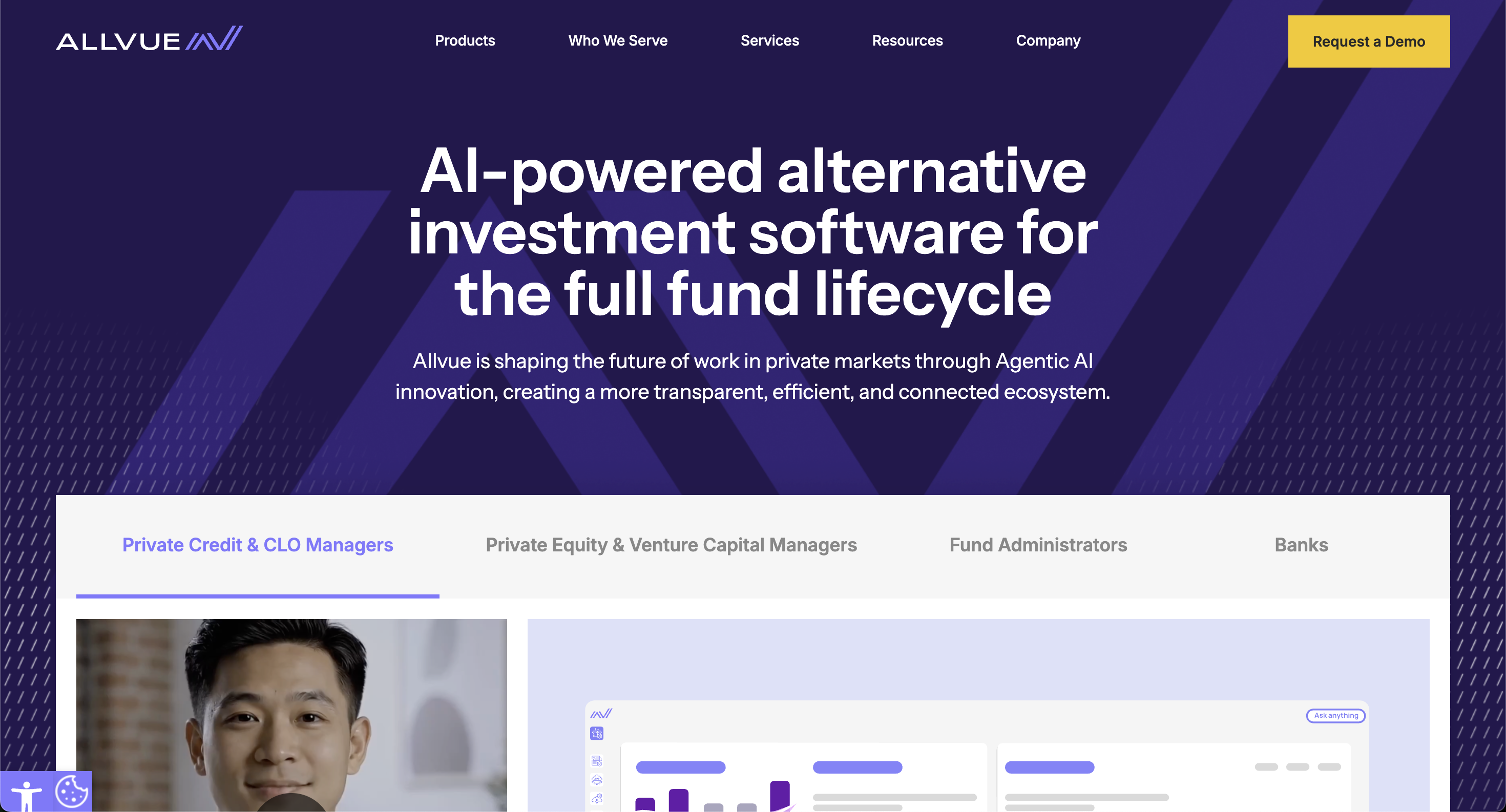
Allvue Systems is an enterprise investment-management platform for the alternative-asset industry, formed from the merger of Black Mountain Systems and AltaReturn. It spans the full fund lifecycle, integrating front, middle, and back office so private capital firms can run fund accounting, portfolio monitoring, and investor relations on one connected suite.
- What you can do with Allvue: Firms manage fund accounting, portfolio monitoring, compliance, business intelligence, and a branded LP-facing investor portal from a single platform. With its investor portal, GPs can get reports, capital account statements, K-1s, and capital call notices online instead of by email, lets LPs securely manage banking, FATCA, and contact details, and tracks investor activity such as document views and report requests.
- Why Allvue stands out: Its strength is enterprise breadth and integration across the entire investment lifecycle, eliminating silos between front, middle, and back office. Built on a Microsoft-based framework and trusted across tens of thousands of funds with more than $500 billion in assets on the platform, it is particularly strong for private credit and direct-lending managers thanks to loan servicing and covenant tracking alongside standard PE and VC fund operations.
- It's best for: Mid-to-large alternative asset managers across private equity, private credit, venture capital, and real estate that need an institutional-grade, integrated back-to-front platform rather than a point solution.
- Pricing: Custom, quote-based pricing scaled to firm size, asset classes, and the modules required, with no public price list or free trial and demos available on request.
Website: Allvue Systems
5. Dynamo Software
Dynamo Software is a cloud-native, AI-powered platform for alternative-asset managers that unifies front, middle, and back office in one configurable system. For LP management specifically, it merges CRM, fundraising, investor relations, and a branded investor portal so GPs can track every LP relationship and communication in a single environment.
- What you can do with Dynamo: GPs manage the full investor lifecycle, including CRM and deal pipeline, fundraising, investor relations, reporting, and an investor portal that gives LPs real-time access to statements, capital calls, distributions, tax documents (via a dedicated Tax Center), and interactive dashboards.
- Why Dynamo stands out: It serves both GPs and LPs, which means the same platform supports fund managers raising and servicing capital and institutional allocators (pensions, endowments, foundations, family offices, funds of funds) managing their own portfolios. Highly configurable across private equity, venture capital, private credit, real estate, infrastructure, and hedge funds.
- It's best for: Established alternative-asset managers and institutional investors that want a deeply configurable, all-in-one system for investor relations and reporting, and are willing to invest in implementation to get it.
- Pricing: Custom, quote-based pricing scaled to firm size, modules, and asset classes, available through a demo.
Website: Dynamo Software
6. InvestorFlow
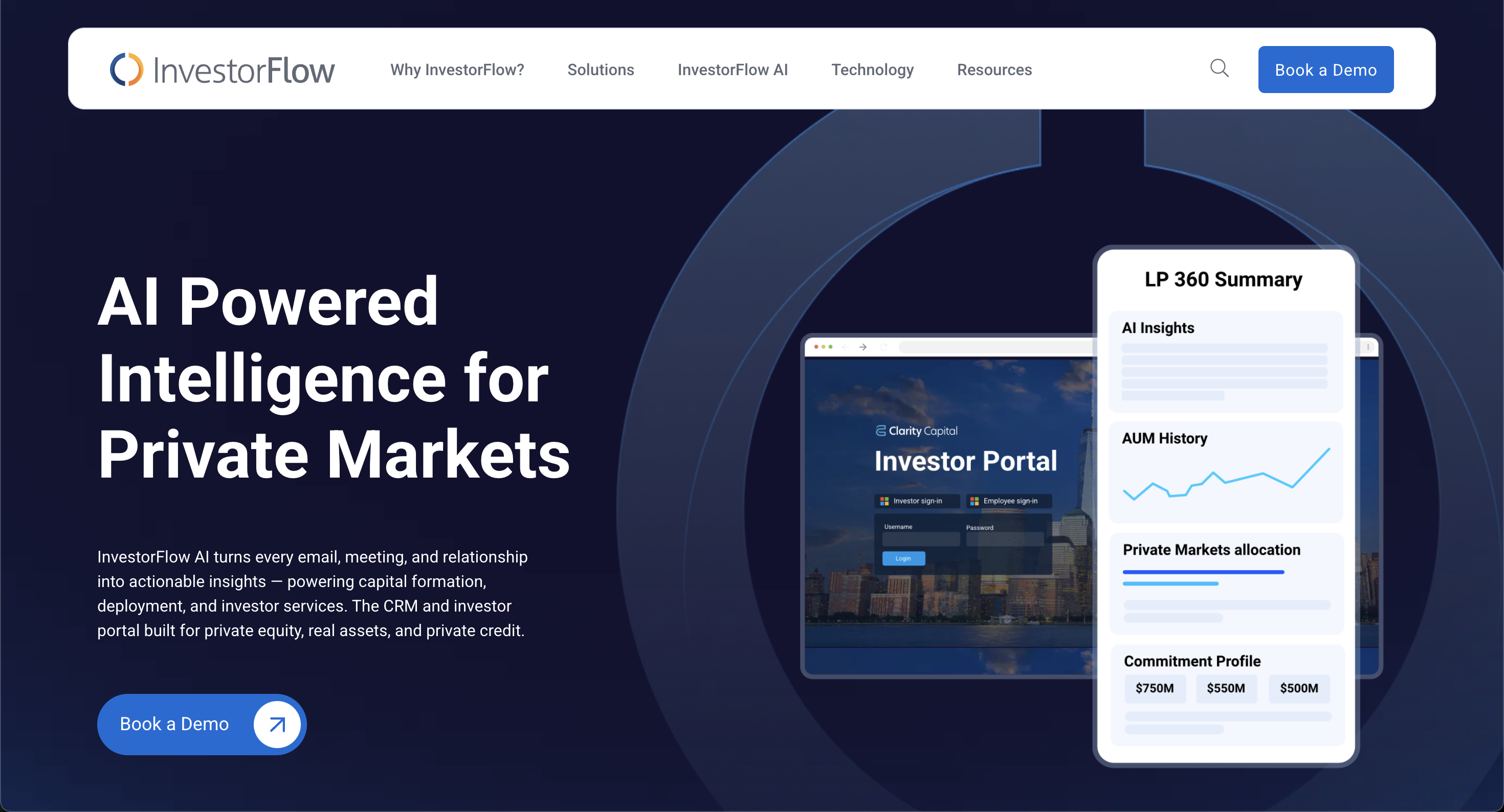
InvestorFlow is an investor and deal engagement platform for alternative asset managers, built natively on Salesforce. It combines a purpose-built private-markets CRM with LP portals and reporting, so firms already standardized on Salesforce can run fundraising and investor relations without rebuilding their CRM infrastructure.
- What you can do with InvestorFlow: Firms manage deal sourcing, pipeline, fundraising, and investor services in one cloud-native platform, and give LPs a configurable portal for reporting, documents, and communications.
- Why InvestorFlow stands out: Its native Salesforce foundation is the core differentiator, pairing Salesforce's enterprise-grade security and ecosystem with private-markets-specific data models, workflows, and portals.
- It's best for: Mid-size to enterprise alternative asset managers and investment banks, especially those committed to Salesforce that need deep customization and enterprise-grade portals.
- Pricing: Custom, quote-based pricing tied to modules, portal needs, and scale, available through a demo.
Website: InvestorFlow
7. Altvia
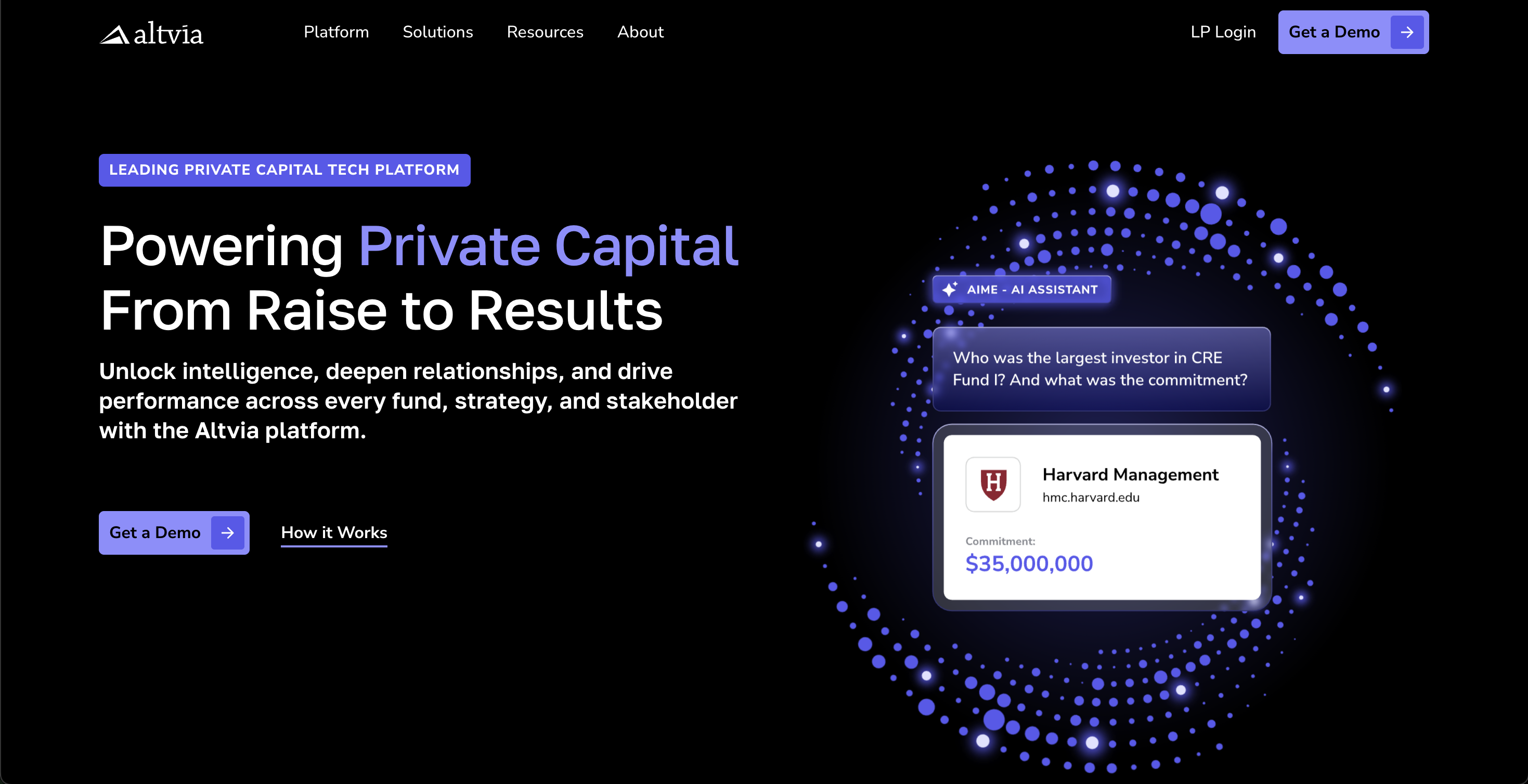
Altvia is a private-capital CRM and LP engagement platform built natively on Salesforce, purpose-built for the full fund lifecycle. Founded in 2006, it serves private equity, venture capital, and fund-of-funds managers who want fund-specific workflows without leaving the Salesforce ecosystem.
- What you can do with Altvia: Through its AIM CRM, investment firms can centralize LP, deal, and interaction data into one source of truth. It provides a secure LP portal for investor communications and document sharing, personalized reporting and dashboards, and an AI assistant (AIMe) that captures calls and emails and surfaces insights. It also connects to onboarding via its OnboardingBridge integration with Passthrough.
- Why Altvia stands out: Like InvestorFlow, it leverages Salesforce as its foundation, but it leans toward firms that want private-markets workflows plus the broader Salesforce AppExchange ecosystem without a heavy custom build. It supports more than 40,000 LP investors across hundreds of firm. Altvia also received a majority investment from Marlin Equity Partners in 2022.
- It's best for: Private equity and venture capital firms already on or open to Salesforce that want full fund-lifecycle CRM, LP engagement, and investor relations in one connected system.
- Pricing: Custom pricing by modules and scale, with third-party listings citing a starting point around $1,800 per year; quotes are available through a demo.
Website: Altvia
8. Passthrough
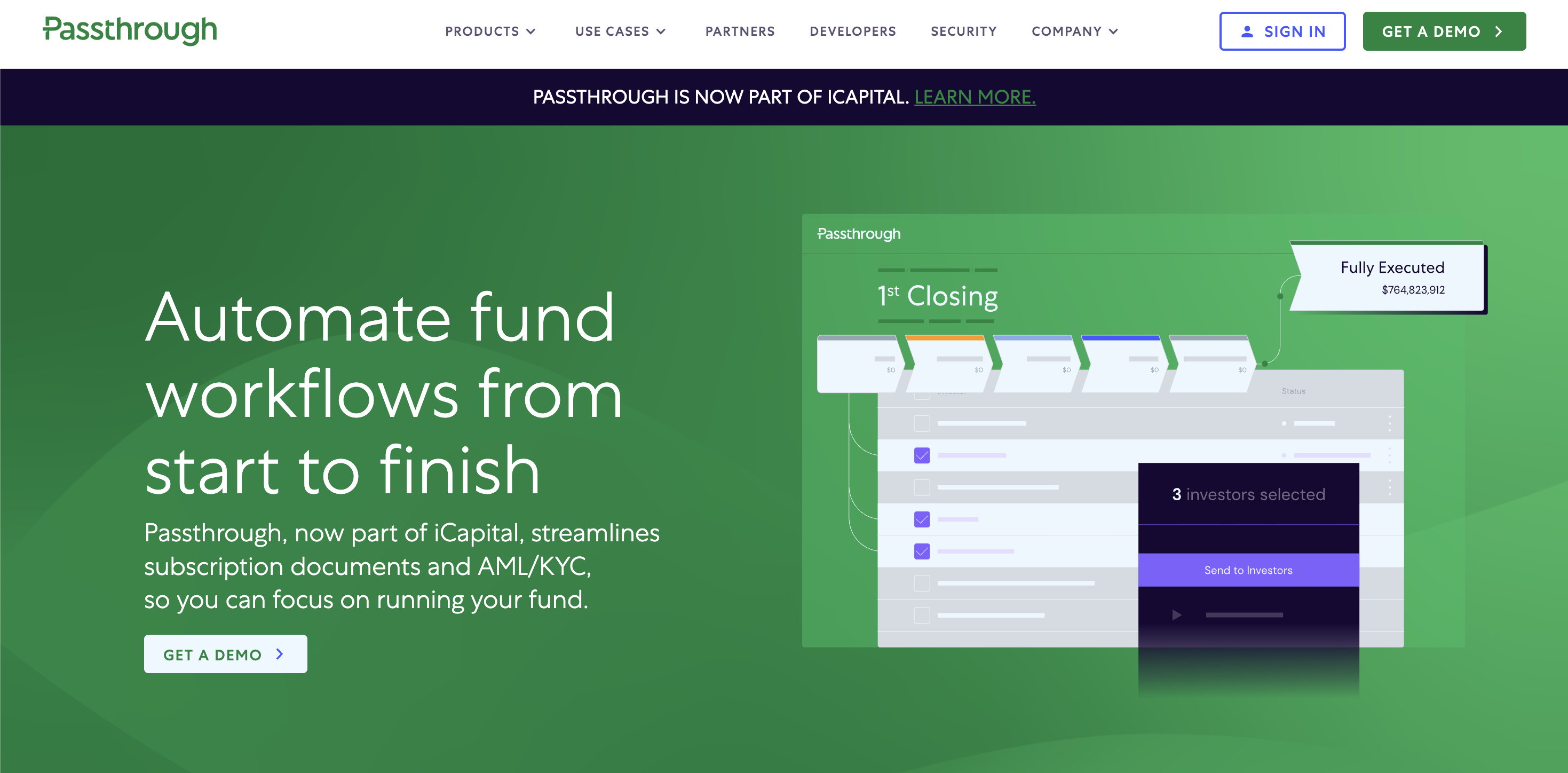
Passthrough is investor onboarding and subscription-document automation software focused on getting LPs from commitment to completed subscription and compliance in a single flow, then feeding that data into the rest of the GP's stack.
- What you can do with Passthrough: Funds digitize their own subscription agreements into a guided, TurboTax-style workflow that LPs complete quickly and accurately, with more than 80% of sub docs coming back in good order without revisions. It bundles electronic subscription documents with initial and ongoing KYC and AML monitoring, collecting and screening data down to the beneficial owner in one workflow. Investor data is normalized on the back end, so returning investors complete repeat subscriptions in about two minutes, and the platform plugs into any CRM, investor portal, or data room via an open API.
- Why Passthrough stands out: It treats onboarding and compliance as the same workflow rather than separate vendors, removing the handoffs that slow closings. It onboards your existing legal documents instead of forcing generic templates, and its data reuse and integrations (including partnerships with Altvia, Allvue, and fund administrators) make it the onboarding layer that feeds a broader LP management stack rather than a standalone silo.
- It's best for: Emerging and established fund managers, and the law firms and administrators supporting them, who want to accelerate closes and handle subscriptions plus KYC and AML in one place.
- Pricing: Custom pricing based on funds, usage, and services, available through a demo.
Website: Passthrough
9. AngelList
AngelList is fund infrastructure and tech-enabled fund administration built primarily for venture capital, and it remains the entry point many emerging managers use to launch and run a fund. Its back office is designed around modern VC vehicles such as venture funds, rolling funds, SPVs, and scout funds, with LP management handled from a single GP dashboard.
- What you can do with AngelList: From one dashboard, GPs market a fund through a branded data room with personalized LP access links and engagement tracking, initiate capital calls and track LP contributions, view all financial transactions, monitor portfolio and fund-level metrics like DPI, TVPI, IRR, and MOIC, and deliver K-1s and accountant-verified financial statements directly to LPs in their own dashboards. It also supports automated capital-call scheduling for rolling funds and handles much of the operational back office so GPs spend less time on administration.
- Why AngelList stands out: Speed and simplicity are the draw. A solo GP can launch a fund and have the full admin stack running the same week, with no third-party integrations required, and the platform supports a very large base of funds, syndicates, and active investors with significant assets on platform. Its design is syndicate- and SPV-centric, which makes it excellent for simple structures and emerging managers.
- It's best for: Emerging VC managers and syndicate leads who want to stand up a fund quickly with onboarding, capital calls, LP reporting, and tax handled in one place. Note that its standardized, service-led approach can feel restrictive for complex or highly customized structures as firms scale.
- Pricing: Custom pricing based on vehicle type and assets, available through a demo or sign-up.
Website: AngelList
10. eFront
eFront, now part of BlackRock, is an enterprise alternative-investment management suite built for complex private-capital operations. It is one of the long-established institutional platforms for fund administration, portfolio data, and investor reporting, and it sits at the heavier, more configurable end of the LP management market.
- What you can do with eFront: Firms run configurable alternatives workflows across fund administration, fund accounting, portfolio monitoring, and investor reporting, with LP-facing reporting and communications delivered through its investor tools. Built for institutional depth, it handles complex fund structures, detailed performance and exposure analytics, and the reporting rigor that large LPs and regulators expect, and it integrates into the broader BlackRock and Aladdin data ecosystem.
- Why eFront stands out: Its strength is institutional-grade breadth and configurability for complex private-capital operations, which is why it is a familiar benchmark for enterprise LP reporting. Backing by BlackRock gives it scale, security, and a data ecosystem few competitors can match, making it a fit for large managers and allocators with sophisticated reporting requirements.
- It's best for: Large, established alternative asset managers, fund administrators, and institutional allocators that need a deeply configurable, enterprise platform for fund administration and LP reporting rather than a lightweight tool.
- Pricing: Custom, enterprise quote-based pricing tied to scale, modules, and structure, available through BlackRock or eFront sales.
Website: eFront
%20(1).png)
