
Share:



![[Blog Banner] Engagement Hub-1](https://anduintransact.com/hs-fs/hubfs/%5BBlog%20Banner%5D%20Engagement%20Hub-1.png?width=760&height=428&name=%5BBlog%20Banner%5D%20Engagement%20Hub-1.png)
For many PE firms, investor relations intensity drops noticeably after the close—a pattern that creates a strategic disadvantage, although leading firms are increasingly treating post-close engagement as continuous.
The post-close period determines LP retention. LPs decide here whether they'll allocate to fund 2. Yet, most GPs treat it as maintenance—sending quarterly emails to passive inboxes with no real engagement strategy.
The cost of this neglect is significant. With median fundraising timelines stretching to 18.1 months in H1 2024 (up from 11.2 months in 2022), every touch point with an LP becomes critical. LPs who feel disconnected post-close are less likely to commit to fund 2.
The Post-Close Engagement Problem
The friction typically starts with communication. After the fund closes, LPs face a fragmented investor journey:
- Monthly or quarterly updates buried in email—usually generic, sent to all LPs equally, without regard for individual interests or investment scope
- Multiple URLs scattered across platforms—webinars here, performance data there, fund documentation somewhere else, all requiring LPs to hunt through bookmarks and inboxes
- Slow, asynchronous communication channels—announcements take weeks to reach all stakeholders, and there's no way to gauge LP interest or feedback in real time
The burden falls on LPs. They have to actively seek information rather than have the firm keep them informed. This friction matters because it signals something larger: that the firm doesn't prioritize investor attention. When an LP completes a subscription and never hears from the GP again except for dry quarterly reports, the relationship feels transactional rather than genuine.
The Stakes Of Poor Post-Close Engagement Are Higher Than Most GPs Realize
Fundraising velocity. Median fundraising timelines have doubled in two years. Returning LPs commit faster—they already know your strategy and track record. Engaged LPs shorten your fundraising cycle dramatically.
Second-fund commitment rates hinge on post-close experience. LPs make reinvestment decisions between funds. Firms that maintain engagement win repeats. Firms that go dark during this window lose LPs they can't rebuild relationships with during fund 2 fundraising.
Lost visibility into LP intent. Without structured engagement, you don't know which LPs are considering alternatives, interested in co-investments, or planning exits. Silent LPs become departed LPs.
Slower deal capture. When you need to surface co-investment opportunities or gauge secondary interest, fragmented communication delays responses. Engaged LPs respond immediately. Disengaged ones create friction that costs you deal flow.
Most firms rely on a combination of email, occasional webinars, data rooms, and generic investor websites. Each channel is siloed:
- Email is asynchronous, cluttered, and easy to miss
- Data rooms and portals are static and compliance-focused, not engagement-focused
- Generic websites lack personalization and feel impersonal
- Scheduled webinars are one-time events that don't create ongoing dialogue
None of these channels is designed to keep an LP meaningfully engaged over the years. They're designed to communicate at LPs, not with them.
The Engagement Hub: Turning Fragmented LP Journey into an Engaged, End-to-End Experience
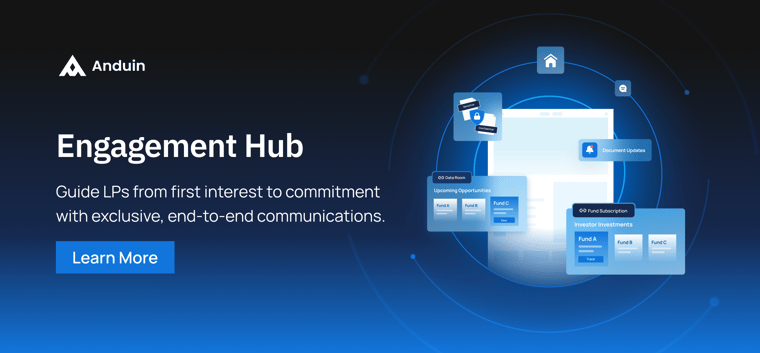
An engagement hub is a private, branded platform built for LP engagement—not compliance like data rooms, not generic like public websites.
Private. Restricted to your LP base. Sensitive information—performance data, pipeline opportunities, strategic initiatives—lives here securely, not scattered across email and public sites.
Personalized. Content segmented by investor type and interest. Pension funds see infrastructure updates. Family offices see co-investment pipelines. Granular permissioning ensures sensitive info reaches only intended audiences.
Engagement-first. LPs visit to stay informed: access performance updates, get event notifications, preview announcements, discover co-investment opportunities, and watch webinars. It's a destination, not a compliance archive.
Branded. Built with your firm's identity, not a generic platform. Reinforces professionalism and attention to detail.
Easy to maintain. Web-builder functionality means your IR team updates content and adjusts permissioning without engineering. You adapt as priorities shift.
The difference between firms stuck in legacy approaches and those building for the future is stark:
Outdated vs. Modern Post-Close Engagement
| Outdated Approach | Modern Approach |
|
Fragmented channels Email, data rooms, websites, and portals are all separate. LPs hunt across platforms. |
Centralized hub Single destination where all updates, events, opportunities, and communications live. |
|
One-size-fits-all All LPs get the same updates regardless of focus or stage. |
Personalized Pension funds see infrastructure updates. Family offices see co-investment pipelines. Content is tailored to LP interest. |
|
Batch communication Quarterly reports, annual emails, occasional announcements. Long silences between touchpoints. |
Consistent cadence Lightweight updates flow regularly. Portfolio highlights surface as they happen. Events promoted with one-click RSVP. |
|
Text-heavy documents PDF reports attached to emails. Static information. |
Multiple formats Videos, webinars, infographics, reports, announcements, all in one place. |
Why This Matters for Your Firm
Engaged LP bases convert faster during fundraising. They commit quicker, ask fewer questions, and source co-LPs. But the real advantage is deeper: loyalty that compounds over decades.
LPs who feel connected to your firm—who hear about opportunities first, whose interests are respected, who have easy access to information—stay for fund 3, fund 4, and beyond.
In an industry where capital is abundant but attention is scarce, engagement infrastructure is now a competitive advantage. Firms treating investor relations as back-office maintenance are losing. Firms treating it as a strategic lever—shaping LP retention, fundraising velocity, deal access—are winning.
The question isn't whether you need better post-close engagement. The question is how quickly you can build it.



.png)


